Our planters and illuminated furniture are manufactured with Rotational Moulding.
Here’s a concise overview of rotational moulding (also known as rotomoulding):
What Is Rotational Moulding?
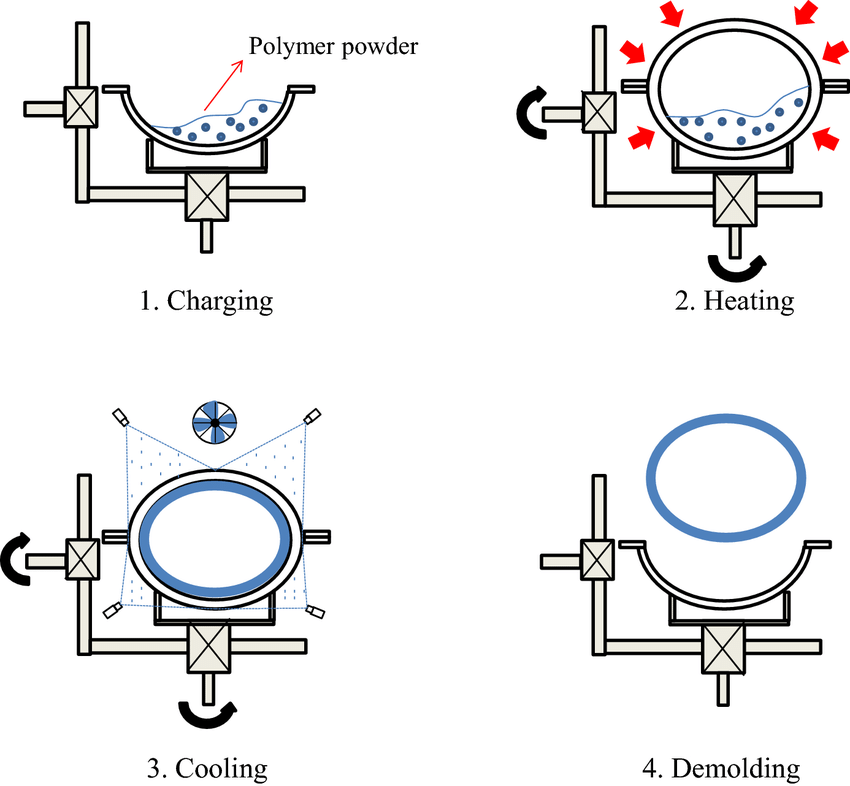
Rotational moulding is a low-pressure thermoplastic manufacturing process for producing hollow plastic parts. Typically, powdered resin (most commonly polyethylene) is placed in a sealed metal mould, which is then rotated slowly around two perpendicular axes while heated. This causes the material to melt and coat the internal surface uniformly, forming a seamless hollow shape .
Process Steps
- Loading: The mould is filled with a precise weight of plastic powder and sealed .
- Heating & Rotation: The sealed mould rotates bi-axially in an oven. As temperature rises, the powder melts and adheres to the mould walls in a consistent layer .
- Cooling (still rotating): Cooling occurs inside a chamber—via air, mist, or spray—while the mould continues to rotate to prevent sagging or uneven thickness .
- Demoulding: Once sufficiently cooled, the mould is opened and the part is removed .
Key Advantages
- Low tooling costs: No need for high-pressure tooling enables economical small production runs .
- Design flexibility: Ideal for complex, seamless shapes, including undercuts, inserts, and textured surfaces .
- Uniform wall thickness: Thickness stays consistent, increasing strength; corners often get thicker enhancing durability .
- Minimal waste: No sprues or runners—unused powder can often be reused .
- Large or oversized parts: Single-piece parts up to tens of thousands of liters are feasible .
Materials & Applications
- Materials: Polyethylene (PE) dominates (~97%), though limited use of PVC plastisol, polypropylene, and certain polyamides occurs with special processing .
- Typical products:
- Water, chemical, and fuel tanks
- Industrial containers and pallets
- Playground equipment, kayaks, and outdoor furniture
- Automotive parts, traffic cones, and road safety gear .
Limitations & Considerations
- Long cycle times: Typically only 1–2 cycles per hour due to extended heating and cooling periods .
- Material limitations: Process suits materials that tolerate slow heating without degradation; not all polymers are suitable .
- Complex process control: Environmental factors (e.g. ambient temperature, humidity), mould material, and powder quality can impact outcomes .
Real-world Insights
A user on Reddit succinctly summarized it as:
“The method involves loading powder resin, heating, and slowly rotating on two axes… ideal for producing seamless, structurally sound items with design flexibility” .
Summary
Rotational moulding offers a cost-effective, versatile, and sustainable way to produce large, seamless plastic parts. Its strength lies in flexibility and uniformity, though slower throughput limits its use in high-volume products.
The image above illustrate the four stages:
- Loading,
- Heating & rotation,
- Cooling,
- Demoulding.